

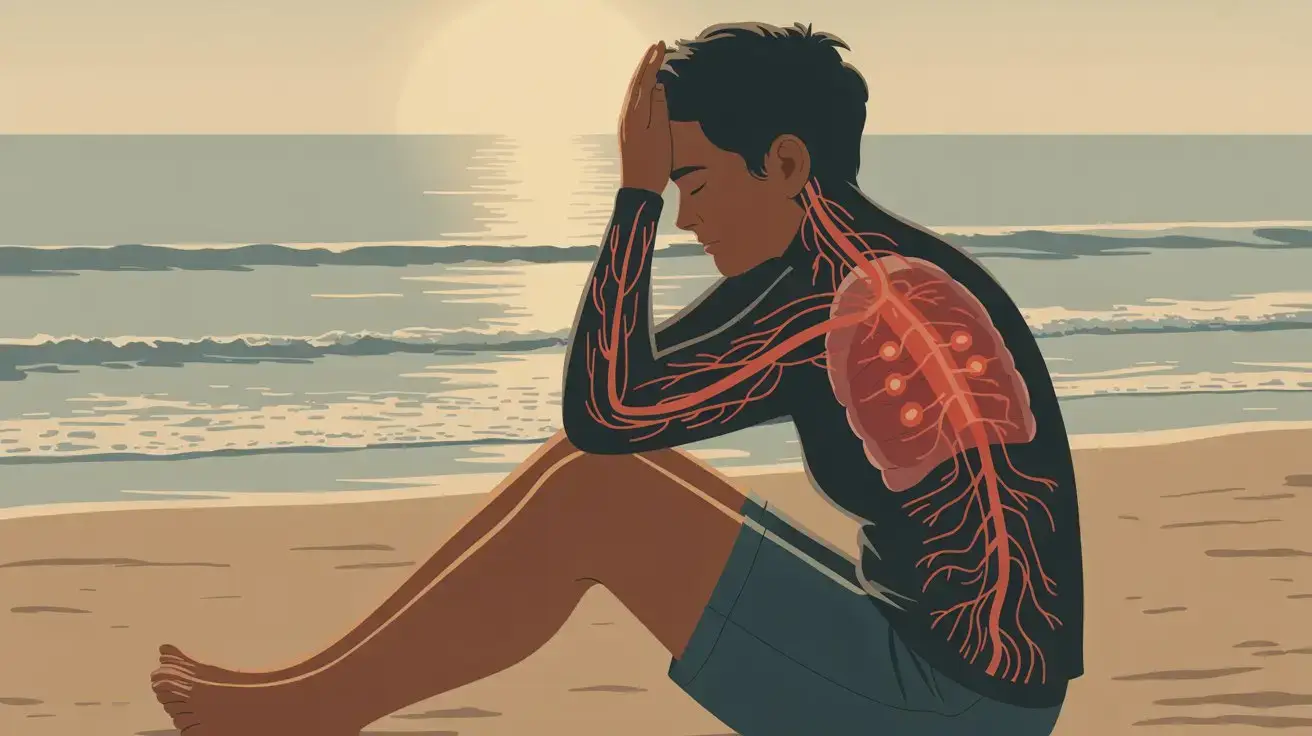
You took the time off. You went somewhere beautiful. You slept in, exercised, ate well, disconnected from email. You did everything right.
And within 72 hours of returning to work, you felt exactly as exhausted as before you left—maybe worse.
Here’s what nobody told you: rest doesn’t fix a dysregulated nervous system. It can’t. That’s not what rest is designed to do.
This isn’t a character flaw or a sign that you’re broken. It’s neurobiology. And once you understand what’s actually happening in your body, everything changes—including what you need to do about it.
The Short Version
Burnout isn’t just exhaustion you can sleep off. It’s a state where your nervous system has been running emergency protocols for so long that it’s forgotten how to do anything else. Rest addresses fatigue. It doesn’t address the underlying dysregulation that’s causing the fatigue in the first place.
What Most People Miss:
- Traditional rest assumes your nervous system can actually receive rest—many burned-out nervous systems can’t
- The inability to relax even when you finally have time isn’t a discipline problem; it’s a physiological state
- “Pushing through” burnout doesn’t build resilience; it trains your nervous system to stay stuck in overdrive
- Recovery requires active nervous system work, not just passive rest
The Fundamental Misunderstanding About Burnout
When most people think about burnout, they think about batteries. You’ve used up your charge, so you need to recharge. Simple.
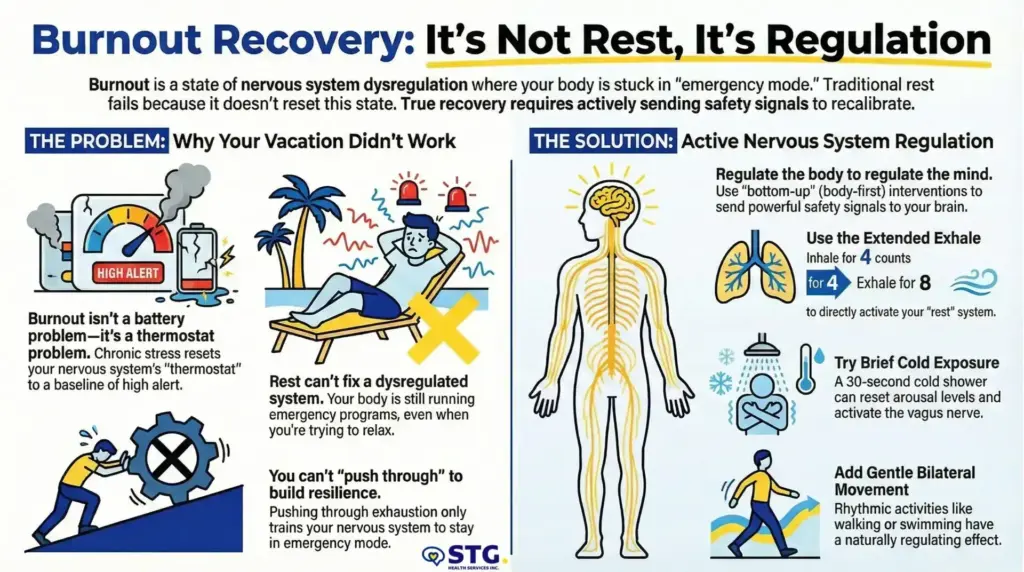
Except burnout isn’t a battery problem. It’s a thermostat problem.
Your autonomic nervous system acts like a thermostat, constantly adjusting your internal state to match what it perceives as needed. Under normal conditions, it shifts between activation (sympathetic—fight or flight) and restoration (parasympathetic—rest and digest) throughout the day. You get stressed, you come back down. You push hard, you recover. The system self-regulates.
But here’s what happens under chronic stress: that thermostat gets recalibrated. The “normal” setting shifts. Your nervous system starts treating high alert as the baseline. Not because something’s wrong with you, but because your system is doing exactly what it evolved to do—adapting to what it perceives as a dangerous environment.
The problem is that what works as a short-term survival adaptation becomes destructive when it persists. Your nervous system doesn’t know the difference between a tiger chasing you and a demanding board, an aggressive competitor, or a struggling cash flow. Threat is threat. And when threat becomes constant, your system adjusts accordingly.
This is why you can take two weeks off and still feel wired. Your thermostat is set to “emergency.” Lying on a beach doesn’t reset it.
Research from the Journal of Occupational Health Psychology (2019) found that burnout-related exhaustion showed no significant improvement from vacation time alone without additional intervention. The recovery was temporary because the underlying nervous system state hadn’t changed—participants were resting in a body still running emergency programming.
What Burnout Actually Looks Like in Your Nervous System
Understanding the neuroscience here isn’t academic—it’s practical. When you know what’s happening, you stop blaming yourself for “not relaxing right” and start addressing the actual problem.
The Three States That Matter
Your autonomic nervous system operates primarily in three modes, beautifully mapped by Dr. Stephen Porges’ polyvagal theory:
Ventral Vagal (Safe & Social): This is your optimal state. You feel calm but alert. You can think clearly, connect with others, and handle challenges without feeling overwhelmed. Your heart rate variability is good, your digestion works properly, and your immune system functions normally. This is where you do your best work.
Sympathetic (Fight or Flight): Your accelerator. Heart rate increases, stress hormones flood your system, and non-essential functions (digestion, immune response, creative thinking) get deprioritized. This state exists for genuine emergencies. It’s supposed to activate briefly and then resolve.
Dorsal Vagal (Shutdown): Your emergency brake. When threat becomes overwhelming—or when you’ve been in sympathetic activation too long—your system can drop into conservation mode. This shows up as numbness, dissociation, depression, profound fatigue, or feeling “checked out.” It’s your nervous system’s last-resort protection mechanism.
The Burnout Cycle
Here’s what typically happens with the high-performers I work with:
Phase one, you push through increasing demands using sympathetic activation. You’re stressed but productive. The adrenaline feels almost good—urgent, important, alive.
Phase two, that level of activation starts depleting you. You need more stimulation (coffee, deadlines, crisis) to maintain the same output. You’re running hot, and your body starts showing strain: sleep problems, digestive issues, getting sick more often.
Phase three, the crash. Your system can’t maintain sympathetic overdrive indefinitely, so it starts oscillating—sometimes wired, sometimes collapsed. You might feel anxious in the morning and exhausted by afternoon. High-alert followed by can’t-get-off-the-couch. This oscillation itself is exhausting.
Phase four, your nervous system settles into a “new normal” that’s actually a chronic blend of activation and shutdown. You’re tired but can’t sleep. Wired but unproductive. Craving rest but unable to receive it.
This isn’t weakness. It’s physiology. And it explains why rest alone doesn’t resolve it—you’re trying to charge a battery that’s not the problem. The problem is the system that manages the charging.
Why Traditional Recovery Strategies Fail
Let me be direct about something: most burnout advice assumes your nervous system is functioning normally. It assumes that if you stop doing the stressful thing, your body will automatically return to baseline.
For mild stress, that’s true. For genuine burnout, it’s not.
The Vacation Paradox
I see this pattern constantly: a founder or executive takes time off—real time off—and either can’t enjoy it, gets sick immediately, or feels just as depleted afterward.
This isn’t failure. It’s your nervous system doing exactly what dysregulated nervous systems do. Here’s what happens:
When you’re chronically activated, your stress hormones (cortisol, adrenaline) are running the show. Your body adapts to that chemistry. Then you remove the external stressors, and suddenly there’s a mismatch between your internal state (still producing stress chemistry) and your external environment (no longer threatening).
That mismatch often feels worse than the original stress. You’re restless when you should be relaxed. You can’t stop thinking about work. Small things irritate you. You might feel depressed without understanding why—you finally have what you wanted, and now you feel terrible.
Additionally, once the adrenaline drops, your immune system sometimes takes the opportunity to finally do its job. Hello, vacation cold. Your body has been suppressing immune function to deal with the “emergency,” and now that the emergency has paused, everything it was holding back surfaces.
The Sleep Trap
Another common failure point: “I’ll catch up on sleep.”
But burnout-level nervous system dysregulation often creates a brutal paradox around sleep. You’re exhausted, so you should be able to sleep. But your system is running emergency programming, which means it’s hypervigilant. Hypervigilance and sleep are fundamentally incompatible—from an evolutionary perspective, you can’t watch for threats while unconscious.
So you lie there, exhausted, unable to sleep. Or you fall asleep but wake at 3 AM with your mind racing. Or you sleep but wake up unrefreshed because you never reached the restorative deep-sleep stages your body actually needs.
Trying harder to sleep makes this worse. Sleep is a parasympathetic function—it requires your restoration system to be online. You can’t force your way into parasympathetic dominance through effort. Effort is, by definition, activation.
The “Push Through” Backfire
Here’s something that often surprises people: the strategy that got you into burnout keeps getting reinforced because it works—in the short term.
When you push through exhaustion and still perform, your nervous system learns that the threat (deadline, quarter, launch) required that level of activation. Each time you push through, you’re essentially training your system to stay in emergency mode longer.
This creates a vicious cycle. The more you prove you can push through, the more your system believes it needs to stay activated. You’re not building resilience; you’re building a increasingly hair-trigger stress response.
I’ve worked with executives who wear their ability to push through as a badge of honor—and I get it. That capacity served you. It got you where you are. But the same trait that drove your success is now keeping you stuck.
What Actually Works: Active Nervous System Regulation
Recovery from genuine burnout requires more than rest. It requires actively working with your nervous system to reset that thermostat.
This isn’t about relaxation techniques, though those can help. It’s about understanding that your nervous system learns from experience, and you need to give it different experiences than the ones that created the dysregulation.
The Core Principle: Safety Signals
Your autonomic nervous system is constantly scanning for cues of safety or danger—a process called neuroception. This happens below conscious awareness. You don’t decide whether to feel safe; your nervous system decides for you based on the signals it’s receiving.
For recovery, you need to flood your system with safety signals. Not just the absence of threat, but active cues that communicate: “The emergency is over. You can stand down.”
This sounds simple, but it’s not. Because your conscious mind understanding that you’re safe doesn’t automatically convince your nervous system. Your nervous system responds to body-based, sensory, relational signals—not rational arguments.
Practical Interventions That Address the Actual Problem
Regulate the Body to Regulate the Mind
Your nervous system state is bidirectional. Yes, your mental state affects your body. But—and this is key—your body state affects your mind, often more powerfully.
This means bottom-up interventions (body-first) often work better than top-down interventions (mind-first) for genuine nervous system dysregulation. You can’t think your way out of burnout, but you can shift your physiological state in ways that change what thoughts are even possible.
Practical applications:
Cold exposure (briefly): A 30-second cold shower ending activates your vagus nerve and can shift you out of sympathetic dominance. This isn’t about toughness—it’s about giving your nervous system a clear, non-threatening signal that resets arousal levels.
Extended exhale breathing: Making your exhale longer than your inhale directly activates parasympathetic response. Try inhaling for 4 counts, exhaling for 8. Not because it’s magic, but because slow extended exhalation is literally a safety signal to your autonomic system.
Gentle bilateral movement: Walking, swimming, or any rhythmic side-to-side movement has a regulatory effect on the nervous system. This is partly why walking meetings feel different than sitting meetings—the movement itself is helping regulate your state.
Rebuild Capacity Gradually
A dysregulated nervous system has a smaller “window of tolerance”—the range of activation you can experience while still functioning well. Recovery involves gradually expanding that window, not testing its limits.
This means starting smaller than you think you need to. Five minutes of a regulatory practice, done consistently, beats an hour done once. You’re not trying to force your system into a new state; you’re teaching it, gently, that a different state is possible.
It also means noticing the early warning signs of activation and responding before you’re fully triggered. The goal is to catch the escalation early, not prove you can handle more intensity.
Address the Relational Component
Humans are social mammals, and our nervous systems are designed to be regulated in relationship. Isolation—physical or emotional—sends threat signals to your nervous system regardless of your conscious beliefs about being fine alone.
For many executives and founders, this is uncomfortable territory. You’re used to being the one who handles things. Vulnerability feels like weakness. But your nervous system evolved in tribal contexts where isolation meant danger. It still responds that way.
This doesn’t mean you need to become emotionally dependent or over-share. It means noticing that genuine connection with safe people has a physiological effect on your nervous system. A real conversation with someone who gets it can do more for your regulation than a week of solo meditation.
The Decision Framework: Is This Burnout or Something Else?
Not all exhaustion is burnout, and the intervention that works depends on accurate assessment. Use this framework to clarify what you’re actually dealing with.
Acute Stress vs. Burnout
Acute Stress:
- You’re tired but recover with rest
- Sleep helps (and you can sleep)
- Weekends and vacations feel restorative
- You still feel like yourself, just depleted
- Your emotions are proportional to what’s happening
Burnout:
- Rest doesn’t restore you
- Sleep is difficult or unrefreshing
- Time off makes you feel worse or no better
- You feel disconnected from yourself or your values
- Emotional responses are muted, volatile, or inappropriate to context
If you’re in acute stress, rest may actually be what you need. If you’re in burnout, rest alone won’t be sufficient.
Burnout vs. Depression
There’s significant overlap here, and they can coexist. But distinguishing between them matters for intervention.
Burnout:
- Typically connected to work or performance demands
- Responds to changes in work environment or load
- Exhaustion is the primary feature
- Sense of cynicism often specifically related to work
Clinical Depression:
- Pervades all life domains, not just work
- Doesn’t resolve with environmental changes alone
- Includes persistent hopelessness, worthlessness, or guilt
- May include thoughts of self-harm or suicide
If you’re experiencing symptoms of depression, especially any thoughts of self-harm, please reach out to a mental health professional. This isn’t something to handle alone.
When to Seek Professional Support
Consider working with a therapist, particularly one trained in somatic or nervous system approaches, if:
- Your symptoms have persisted more than three months
- Rest and basic lifestyle changes haven’t helped
- You’re experiencing significant impacts on relationships or function
- You notice yourself using substances to manage (alcohol to wind down, stimulants to activate)
- You feel disconnected from emotions or from your sense of self
- You have a trauma history (trauma and burnout interact and complicate each other)
Implementation: A Four-Week Foundation
This isn’t a comprehensive program—but it’s a starting point that addresses the actual problem rather than just the symptoms.
Week One: Assessment and Baseline
Before changing anything, spend a week noticing. Three times daily (morning, mid-day, evening), pause and rate your activation level 1-10. Notice patterns: When are you most activated? What precedes the spikes? What happens to your body when you’re stressed?
This isn’t about fixing anything yet. It’s about building awareness of a system that’s been running outside your conscious attention.
Week Two: Introduce Micro-Regulation
Add one brief regulatory practice: 5 minutes of extended-exhale breathing, morning and evening. Not because this will fix everything, but because you’re beginning to teach your nervous system that another state is possible.
Continue tracking your activation. Notice whether the practice affects your levels—not to judge, just to gather data.
Week Three: Expand the Practice
Extend to 10 minutes morning and evening, and add a midday check-in. On days when your activation is highest, try one additional brief intervention: a 2-minute walk, 30 seconds of cold water at the end of a shower, or a genuine conversation with someone safe.
Notice what helps and what doesn’t. Everyone’s nervous system is different; you’re finding what works for yours.
Week Four: Structural Assessment
With three weeks of data, you can see patterns. Now ask: What structural elements of your work are keeping your nervous system in threat mode? What changes are within your control?
This might mean delegating differently, changing how you structure your day, addressing a relationship issue, or having a conversation you’ve been avoiding. The nervous system work makes this easier, but it doesn’t replace addressing root causes.
The Harder Truth
I want to be honest with you about something: nervous system work alone won’t fix unsustainable situations. If your business model requires you to be in emergency mode, if your organization’s culture runs on chronic stress, if you’re in a situation that is genuinely threatening—no amount of breathing exercises resolves that.
Recovery from burnout often requires changes that feel threatening: boundaries, reduced ambition, walking away from things that aren’t working, asking for help, having difficult conversations. The nervous system work supports you in making those changes, but it doesn’t make them unnecessary.
The executives and founders who recover from burnout aren’t the ones who learn to tolerate more stress. They’re the ones who develop the capacity to build lives and businesses that don’t require constant emergency mode to function.
That’s a longer project. But it starts with understanding what’s actually happening in your body, and giving your nervous system what it actually needs—not just rest, but regulation.
Moving Forward
Burnout is a signal. Not a signal that you’re weak or that something’s wrong with you—a signal that your system has adapted to unsustainable conditions in the only way it knew how.
The recovery path isn’t about returning to your previous capacity so you can do the same things that burned you out. It’s about building a different relationship with your own nervous system, one where you can access high performance without requiring emergency activation.
That capacity—the ability to be effective without being in crisis mode—is what sustainable leadership actually looks like. It’s what allows you to think clearly when others are reactive, to make good decisions under pressure, and to maintain the long-term perspective that drives real success.
Your nervous system learned to stay activated because that’s what seemed necessary. It can learn something different. But it won’t learn it from rest alone.
It learns from different experiences. And that process starts now.
This article is intended for educational purposes and does not constitute medical or psychological advice. If you’re experiencing symptoms of burnout, depression, or anxiety, please consult with a qualified healthcare provider.
About the Author: Dr. Chris de Feijter practices psychotherapy specializing in adults navigating ADHD, burnout, BPD, and nervous system dysregulation. The insights in this article draw from clinical work with executives, founders, and high-performers who discovered that their greatest strengths and their burnout often share the same root.
Sources & Methodology: This article integrates polyvagal theory (Porges, 2011), research on burnout from occupational health psychology, and clinical observations from therapy practice. The nervous system framework draws on somatic experiencing and polyvagal-informed approaches. While research continues to evolve in this area, the physiological foundation—that chronic stress creates nervous system adaptations that persist beyond the removal of stressors—is well-established in the literature.