


Why the strategies that built your success are now working against you
Here’s something I’ve noticed working with executives and founders over the years: the people most likely to burn out aren’t the ones who lack drive or discipline. They’re the ones who have too much of both—applied in exactly the wrong direction.
The high performers I see aren’t struggling because they don’t know burnout is a problem. They’ve read the articles. They know they should “practice self-care” and “set boundaries.” What keeps them stuck is something more insidious: a set of thought patterns so deeply woven into their success that questioning them feels like questioning their identity.
These aren’t character flaws. They’re mental habits that served you brilliantly on the way up—and are now slowly taking you apart.
The TL;DR (But Please Keep Reading)
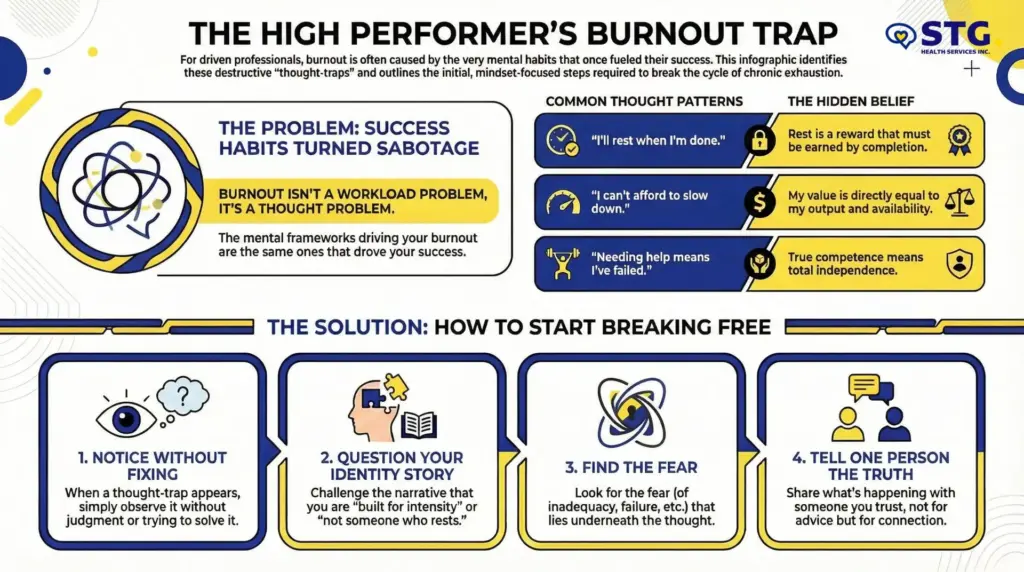
Burnout in high performers is less about workload and more about the mental frameworks that make rest feel dangerous, boundaries feel like weakness, and self-care feel like self-indulgence.
What most people miss:
- The thought patterns driving your burnout are often the same ones that drove your success—which is why they’re so hard to see
- “Pushing through” works until it doesn’t, and the transition happens faster than you expect
- Recovery isn’t about working less; it’s about dismantling the belief systems that make sustainable performance feel impossible
“I’ll Rest When I’m Done”
This is perhaps the most universal thought-trap among high performers, and the most quietly destructive.
The logic feels airtight: there’s a finish line ahead—this quarter, this funding round, this product launch—and once you cross it, you’ll finally ease up. You’ve been telling yourself some version of this story for years. Maybe decades.
What actually happens is that each finish line reveals another one behind it. Not because you’re greedy or insatiable, but because that’s how achievement-oriented minds work. We’re wired to see the next objective the moment we complete the current one. The rest you’ve been promising yourself keeps receding like a mirage in the desert.
A 2023 study in the Journal of Applied Psychology found that executives who consistently deferred recovery showed significantly higher rates of chronic exhaustion than those who integrated rest throughout high-demand periods—even when total work hours were similar. The researchers described this as “recovery debt,” and like financial debt, it compounds.
The deeper issue here isn’t time management. It’s a belief that you haven’t yet earned rest. That rest is a reward for completion rather than a requirement for continuation. Somewhere along the way, you internalized the idea that relaxation without total completion is laziness.
It’s not. And that story is costing you more than you realize.
“This Is Just How I’m Built”
High performers often develop an identity around intensity. You’re the one who can outwork anyone. The one who doesn’t need as much sleep. The one who thrives under pressure.
And for a while, maybe that was true. But here’s what I want you to consider: the human nervous system isn’t designed for chronic activation. What feels like “thriving under pressure” is often your body running on stress hormones—cortisol and adrenaline—that provide real performance benefits in the short term and real damage over time.
Research from the American Institute of Stress shows that chronic stress exposure physically changes brain structure, particularly in areas governing executive function and emotional regulation—the exact capabilities you need most. You may feel sharp in the moment, but you’re borrowing against cognitive resources you’ll need later.
The thought-trap here is mistaking adaptation for preference. Your body has gotten remarkably good at operating in survival mode because it had to. That’s not the same as being “built for it.” A car can run at redline for a while too, but that doesn’t mean it should.
What would it mean if the identity you’ve built around relentless intensity isn’t actually who you are—but rather a coping strategy that’s outlived its usefulness?
“I Can’t Afford to Slow Down”
This one has real teeth, especially for founders and executives whose organizations genuinely depend on them. The thought pattern goes: too many people are counting on me, there’s too much at stake, the whole thing will fall apart if I step back.
Let me acknowledge something first: your fear isn’t irrational. You probably are load-bearing in important ways. Slowing down does carry real risks.
But here’s the question nobody wants to ask: what’s the risk of not slowing down?
Research published in Harvard Business Review found that burned-out leaders make measurably worse decisions, particularly around risk assessment and interpersonal judgment. They’re more likely to miss important signals, alienate key team members, and double down on failing strategies.
The math most high performers do is: “Slowing down = immediate, visible costs. Continuing = no immediate costs.” But that calculation ignores the invisible costs already accumulating—the erosion of judgment, the fraying relationships, the creeping cynicism, the health issues quietly gaining ground.
What I often ask clients to consider: Would you rather step back deliberately now, or be forced to step back completely later? Because burnout doesn’t negotiate. It simply takes.
“Other People Have It Worse”
Ah, the comparison trap. This one’s particularly common among executives and founders because, by most external measures, your life is good. You have resources, opportunities, flexibility that most people don’t.
So when exhaustion sets in, the internal response is often dismissal: “What right do I have to complain? I chose this. Other people would kill for my problems.”
This thought pattern does something sneaky: it uses your privilege against you. It tells you that because your suffering has a nice backdrop, it isn’t real suffering. That because you have options, you’re not allowed to feel trapped.
But here’s the thing—burnout doesn’t check your bank account or your job title. It responds to the gap between demands and resources, between what’s being asked of you and what you have left to give. That gap can exist at any income level, in any role.
More importantly, minimizing your own experience doesn’t actually help anyone else. It just ensures that two people are struggling instead of one—you and whoever you were comparing yourself to. Your exhaustion isn’t a zero-sum competition.
What would change if you gave yourself permission to acknowledge that something isn’t working, without requiring proof that you have it worst?
“If I Just Optimize Better…”
High performers love systems. When something isn’t working, the instinct is to fix it through better planning, better tools, better routines. Maybe a different productivity app. A morning routine. A more efficient workout schedule.
This is the optimization trap, and it’s seductive because it feels proactive. You’re not ignoring the problem—you’re solving it! With spreadsheets!
But burnout isn’t an efficiency problem. You can’t optimize your way out of a value misalignment. You can’t life-hack your way past a nervous system that’s been in fight-or-flight for three years.
What the optimization mindset misses is that sometimes the answer isn’t doing the same things better—it’s doing fundamentally different things. Or doing less altogether. Those options don’t compute in a framework built around continuous improvement.
A study in Frontiers in Psychology found that workers who responded to burnout symptoms with increased productivity efforts showed worse outcomes than those who reduced workload, even when the productivity efforts initially seemed effective. The researchers called this “the effort-recovery paradox”—trying harder delays recovery even when it temporarily masks symptoms.
The hardest question for optimizers: What if nothing is broken except your belief that everything needs to be fixed?
“Needing Help Means I’ve Failed”
This thought-trap runs deep in achievement culture. You got where you are by figuring things out, by being the capable one, by not needing to ask for much. Needing support—whether that’s therapy, coaching, delegation, or just admitting you’re struggling—feels like evidence that you’re not who you thought you were.
But consider this: the skills that got you here aren’t the skills that will get you through. Building something required independence, drive, and the ability to push past resistance. Sustaining yourself requires something different—vulnerability, interdependence, and the ability to receive.
These aren’t signs of weakness. They’re signs of maturity.
Research on high-performing leaders consistently shows that those who build genuine support systems outperform those who try to go it alone. Not because they’re less capable, but because they’re more realistic about what humans actually need.
The thought pattern “needing help means failure” is really just another version of the success strategies that served you earlier. It made sense when you were establishing yourself. Now it’s keeping you isolated when you most need connection.
“I’ll Deal With This Later”
This is the procrastination of self-care, and it’s almost universal among burned-out high performers.
The symptoms are there—the insomnia, the short temper, the Sunday dread, the mysterious health issues your doctor can’t quite explain. You notice them. You even acknowledge something needs to change. But not right now. After this quarter. After this hire. After this thing that’s more urgent.
The problem is that burnout doesn’t wait for a convenient time. It’s not a patient creditor.
What I’ve observed is that the moment someone finally decides to address burnout is almost never when they intended to. It’s when the choice is taken from them—a health crisis, a relationship breaking, a mistake they can’t undo. The “later” that high performers keep promising themselves often arrives as an emergency rather than a plan.
One of the most useful reframes I offer clients: What if addressing this is the urgent thing? What if the business problem, the leadership problem, the performance problem you’re trying to solve is actually downstream of a human sustainability problem you keep postponing?
Recognizing Yourself: A Quick Self-Assessment
Consider which of these statements feel familiar:
| Thought Pattern | The Hidden Belief | What It Costs You |
|---|---|---|
| “I’ll rest when I’m done” | Rest must be earned through completion | Chronic exhaustion, perpetual delay of recovery |
| “This is just how I’m built” | My intensity is identity, not adaptation | Physical decline disguised as strength |
| “I can’t afford to slow down” | My value equals my output | Declining judgment, relationship erosion |
| “Other people have it worse” | My suffering doesn’t count | Delayed acknowledgment, worsening symptoms |
| “If I just optimize better” | Every problem has a productivity solution | Effort without recovery, diminishing returns |
| “Needing help means failure” | Independence equals competence | Isolation, unrealistic self-expectations |
| “I’ll deal with this later” | Current demands always outrank future wellbeing | Crisis-driven change instead of chosen change |
If three or more of these resonate strongly, you’re not broken or weak. You’re experiencing the predictable consequences of thought patterns that were adaptive in one context and have become maladaptive in another.
So What Actually Helps?
I want to be clear about something: this article isn’t going to end with “10 tips for beating burnout.” That approach tends to trigger the optimization trap we just discussed.
What actually helps is slower and less satisfying than a checklist. It involves examining the beliefs underneath your behaviors, not just modifying the behaviors themselves. A few starting points:
Notice without immediately fixing. The next time you catch yourself in one of these thought patterns, just notice. Don’t argue with it, don’t try to think your way out of it, don’t add it to your self-improvement to-do list. Just observe: “Ah, there’s that pattern again.” Awareness has to come before change.
Question the identity story. The narratives we tell about who we are become self-fulfilling. If you tell yourself you’re “not someone who rests,” you’ll prove yourself right. Try holding those stories more loosely. What if you’re also someone who can operate differently than you have been?
Look for the fear underneath the thought. Each of these thought-traps has a fear at its core—of inadequacy, of loss, of exposure, of irrelevance. Those fears are worth understanding, not suppressing. What would actually happen if you slowed down? What’s the worst-case scenario, and is it as catastrophic as it feels?
Find one person to be honest with. Not for advice. Not to fix it. Just to say out loud what’s actually happening without minimizing it. This is harder than it sounds for people who’ve built identities around having things handled.
A Final Thought
Burnout isn’t a moral failing. It’s what happens when intelligent, driven people apply successful strategies past their point of usefulness. The same intensity, independence, and achievement orientation that built your success can absolutely dismantle your wellbeing if left unchecked.
The good news is that thought patterns, unlike personality, can change. They respond to attention, to new information, to practice. The patterns keeping you stuck right now aren’t permanent features of who you are—they’re habits of mind that developed for good reasons and can be revised for better ones.
More in-depth pieces on specific aspects of high-performer burnout—including the unique challenges of founder psychology, executive isolation, and recovery approaches that actually fit demanding lives—are coming. But if something in this article hit close to home, consider that a signal worth listening to.
Not later. Now.
This article draws on clinical observations from work with executives, founders, and high-performing professionals, alongside peer-reviewed research in occupational psychology and stress physiology. Individual experiences vary, and burnout that significantly impacts daily functioning warrants professional support.
References and Further Reading:
- Sonnentag, S., et al. (2023). “Recovery as a resource: Evidence for a proactive pathway.” Journal of Applied Psychology.
- Salvagioni, D.A.J., et al. (2017). “Physical, psychological and occupational consequences of job burnout: A systematic review.” PLOS ONE.
- American Institute of Stress. (2024). Stress effects on the brain and body.
- Maslach, C., & Leiter, M.P. (2016). “Understanding the burnout experience.” World Psychiatry.
- Harvard Business Review research on executive decision-making under chronic stress (multiple studies, 2019-2024).