

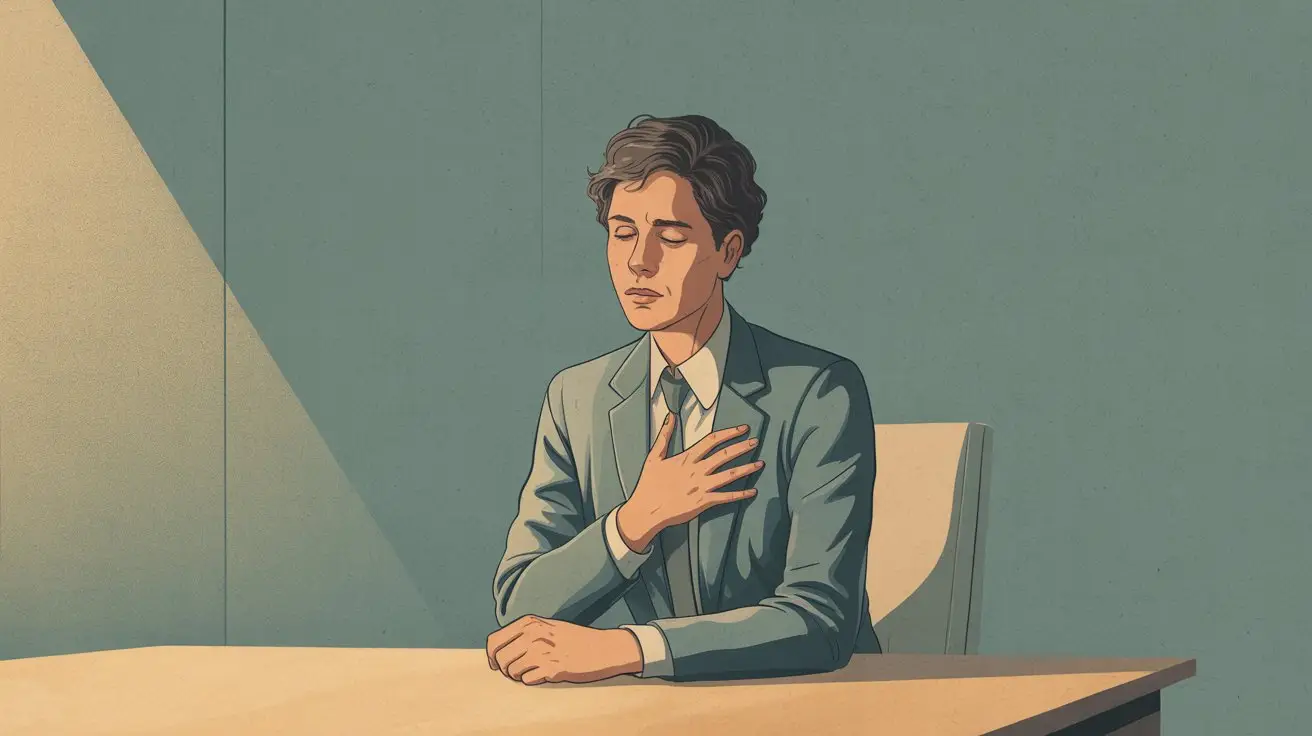
TL;DR: High-performer burnout doesn’t look like collapse — it looks like someone who’s still delivering but can’t recover. When rest stops restoring you, the problem isn’t that you need more of it. The problem is that your nervous system never gets the signal that the threat is over, and specific thinking patterns keep the stress response locked in place. Completing the stress cycle — not just pausing the stressor — is what actually lets your system stand down.
You’re Still Performing. So Why Does Everything Feel Like This?
You took the long weekend. You slept in. Maybe you even booked a few days somewhere warm. And by Tuesday afternoon, you felt exactly the same — flat, reactive, running on something that isn’t quite energy.
This is the burnout pattern most high performers miss entirely, because it doesn’t match what burnout is “supposed” to look like. You’re not crying in the parking lot. You’re not missing deadlines. From the outside, you look fine. You might even look impressive.
But internally, recovery has stopped working. Sleep doesn’t refresh you. Weekends feel like a pause button, not a reset. You can still push through — you’ve always been good at that — but the push is costing more than it used to, and the return on effort keeps shrinking.
If this sounds familiar, you’re not lazy, weak, or broken. You’re likely dealing with a specific physiological and cognitive pattern that “just rest more” will never fix.
Why Rest Alone Stops Working: The Incomplete Stress Cycle
Here’s something most productivity advice gets wrong: removing the stressor and completing the stress response are two completely different processes.
Your body doesn’t run on logic. It runs on physiology. When you encounter a threat — a brutal quarter, a difficult board conversation, a team crisis — your nervous system activates a full stress response. Cortisol rises. Muscles tense. Your system mobilizes for action.
Here’s the problem: that stress response needs a completion signal. In evolutionary terms, that signal was physical — you ran, you fought, you escaped, and your body understood the danger was over. The cycle closed.
Modern high-performer stress almost never closes the cycle. The stressor ends (the meeting is over, the quarter closes, the crisis passes), but your body never got the “safe now” signal. You moved directly from one activation to the next. The meeting ended and you opened your laptop. The crisis resolved and you started planning for the next one.
Research by Emily Nagoski and Amelia Nagoski, authors of Burnout: The Secret to Unlocking the Stress Cycle, identifies this incomplete stress cycle as a primary driver of burnout. The stressor may be gone, but the stress itself is still circulating in your body — and no amount of sitting still will complete it.
This is why a week off can feel like it does nothing. You removed the stressor temporarily, but the accumulated, incomplete stress responses are still queued in your nervous system. You’re resting, but your body is still braced.
The Second Driver: Thinking Patterns That Amplify the Load
Incomplete stress cycles explain why your body won’t stand down. But there’s a cognitive layer that keeps feeding the system new activation, even during “rest.”
High performers tend to develop specific thinking patterns that were adaptive on the way up but become pressure amplifiers under sustained load. These aren’t character flaws — they’re cognitive habits that helped you succeed and now keep your stress response perpetually engaged.
Three patterns show up most consistently in high-performer burnout:
Catastrophizing under uncertainty. Your brain scans for worst-case scenarios and treats them as probable. This was useful when it helped you plan for contingencies. Under chronic stress, it becomes a 24-hour threat-detection system that keeps your nervous system activated even when you’re technically “off.” You’re lying on the couch, but your mind is running projections about what happens if the next quarter misses. Your body can’t tell the difference between imagining the threat and experiencing it.
Perfectionism as a safety strategy. The standard isn’t excellence — it’s the belief that if you do everything perfectly, you can control outcomes and prevent bad things from happening. Under normal conditions, this drives high-quality work. Under burnout conditions, it means nothing ever feels finished, every output carries the weight of potential catastrophe, and your system never gets the signal that you’ve done enough. The stress cycle can’t complete because, by the perfectionism logic, the threat is never actually over.
Hyper-responsibility — carrying what isn’t yours to carry. You feel personally accountable for outcomes that involve dozens of variables and other people’s choices. The team’s morale, the company’s trajectory, your partner’s happiness — it all sits on your nervous system as open loops. Each one is a stress cycle that can’t complete because the “task” is never truly done. This pattern is especially common in founders and senior leaders, and it’s often mistaken for strong leadership rather than recognized as a cognitive load problem.
These three patterns share a common mechanism: they prevent the “safe now” signal from ever arriving. Your thinking keeps generating new threats or reactivating old ones, so your nervous system stays mobilized regardless of what your calendar says.
The Signs That Rest Isn’t Restoring You
Burnout in high performers often gets missed because the visible performance metrics hold steady long after internal recovery has failed. Here’s what to watch for — these are the early and mid-stage signals that your system is running on fumes, not fuel:
Sleep changes that don’t match your fatigue. You’re exhausted but can’t fall asleep, or you fall asleep instantly but wake at 3 a.m. with your mind already running. You might be sleeping seven or eight hours and waking up feeling like you got four. This is your nervous system failing to fully downshift — it stays in a vigilant state even during sleep.
Irritability that’s disproportionate to the trigger. Small things land with outsized force. A minor schedule change, an unclear email, a slow driver — and your reaction is a flash of anger or frustration that doesn’t match the situation. This isn’t a personality problem. It’s a nervous system that’s already maxed out on activation and has no buffer left.
Decision fatigue that hits earlier and harder. You used to make fifty decisions before lunch without blinking. Now choosing what to eat for dinner feels genuinely difficult. When your cognitive load is maxed by unresolved stress cycles and amplifying thought patterns, even small decisions become expensive. You’re not losing your edge — your bandwidth is already allocated to threat management.
Emotional flattening. Things that used to matter — a win, a compliment, a good conversation — land flat. You’re not sad exactly. You’re just… not much of anything. This is your nervous system’s version of energy conservation. When the system has been activated for too long without completion, it starts dampening emotional responses to reduce overall load. It’s protective, but it doesn’t feel like protection. It feels like losing yourself.
The “I should be enjoying this” moment. You’re at dinner with people you love, or you just closed something big, and the dominant thought is that you should be feeling something more than you are. This is one of the most reliable signals that burnout has moved past the early stage.
If you’re recognizing three or more of these, rest isn’t the intervention you need. Cycle completion is.
The 10-Minute Daily Completion Menu
You don’t need a sabbatical to start closing stress cycles. You need brief, consistent physiological completions built into your actual workday — not saved for weekends or vacations.
The Nagoskis’ research and subsequent clinical application suggest that a stress cycle can be completed in as little as 20 to 60 seconds of the right kind of activity, though most people benefit from longer practice as they build the habit. The key is that the activity has to engage your body, not just your mind.
Here’s a practical menu. Pick one or two that fit your day and do them daily — consistency matters more than duration:
Physical discharge (the most reliable method). Even 10 minutes of movement that gets your heart rate up sends the completion signal. This isn’t about fitness — it’s about giving your body the physical “escape” it’s been waiting for. A brisk walk between meetings, a short bodyweight circuit, even vigorous shaking or dancing in your office with the door closed. The movement tells your nervous system: we survived, we got away, we’re safe now.
Controlled breathing with extended exhale. Inhale for four counts, hold for four, exhale for six to eight. The extended exhale activates the parasympathetic nervous system — literally the “stand down” signal your body has been waiting for. Three to five minutes is enough to shift your physiological state. This one works in any setting, including right before a difficult call.
Brief physical contact or social connection. A 20-second hug (long enough for oxytocin release), a genuine laugh with someone, or even a moment of real eye contact and connection. Social bonding signals safety to the nervous system in a way that solitary rest often doesn’t. If you’re remote or solo, a brief phone call with someone who genuinely makes you feel at ease can serve the same function.
Creative expression without stakes. Five minutes of doodling, playing an instrument badly, singing in the car, or writing something with zero intention of sharing it. Creative activity engages different neural pathways and gives the stress-response system a chance to discharge without the performance pressure that keeps it activated.
Intentional transition rituals. A deliberate marker between “work mode” and “home mode” — changing clothes, a specific walk, a particular song, even washing your hands with the conscious intention of setting down the workday. This sounds simple, but without an explicit transition, your nervous system carries the activation straight from one context into the next.
The goal isn’t relaxation. It’s completion. You’re not trying to calm down — you’re trying to finish what your body started hours or days ago.
The Three Cognitive Loops to Address First
Physical cycle completion handles the physiological backlog. But if the three amplifying thought patterns are still running, they’ll keep generating new activation faster than you can discharge it. You need to work both sides.
These aren’t patterns you can think your way out of — they’re deeply reinforced neural pathways. But you can start interrupting them with targeted strategies:
For catastrophizing: Name the pattern, then reality-test. When you notice your mind running worst-case projections, the first step is simply labeling it: “This is catastrophizing.” Naming the pattern creates a small but meaningful separation between you and the thought. Then ask one question: “What is actually happening right now — not what might happen, but what is real in this moment?” Catastrophizing collapses the future into the present. Pulling yourself back to current, concrete reality breaks the loop. You’re not ignoring risk — you’re refusing to let projected risk run your nervous system in the present.
For perfectionism: Practice “good enough” decisions deliberately. Choose one low-stakes area of your day and intentionally do it at 80%. Send the email without the third proofread. Leave the deck slightly imperfect. Let the house stay a bit messy. This isn’t about lowering your standards globally — it’s about teaching your nervous system that imperfect outcomes don’t lead to catastrophe. Each time you let something be good enough and nothing bad happens, you’re providing your brain with corrective data. Start small. The discomfort is the point — it means the pattern is being challenged.
For hyper-responsibility: Identify what actually belongs to you. When you feel the weight of something, ask: “Is this mine to carry, or am I holding someone else’s responsibility?” Draw a literal line if it helps — write down what you can actually control on one side, and what involves other people’s choices, systemic factors, or unknowable variables on the other. Your nervous system treats everything you’ve claimed as an open task. Returning what isn’t yours to its rightful owner closes loops that were never completable in the first place.
These are starting points. They’ll create immediate relief for some people and reveal deeper patterns for others. Both responses are useful information.
When It’s Time to Get Support
Self-directed strategies work well for early and moderate burnout, especially when the patterns are relatively recent. But there are clear signals that working with a therapist will get you further, faster — and trying to push through alone may actually extend the burnout cycle.
Consider booking an intake if you recognize any of the following:
You’ve been implementing recovery strategies consistently for several weeks and the needle isn’t moving. This suggests the patterns are more entrenched than surface-level strategies can reach, or that there’s an underlying factor (trauma history, anxiety disorder, ADHD-related executive function challenges) that needs professional assessment.
Your relationships are taking damage. When burnout starts showing up as withdrawal from people you care about, chronic irritability with your partner or kids, or inability to be emotionally present even when you want to be — the cost has moved beyond your professional life.
You’ve started relying on substances or compulsive behaviors to manage. An extra drink to wind down, doom-scrolling for hours, compulsive work as avoidance, emotional eating that feels out of your control. These aren’t moral failures — they’re signs your nervous system is looking for completion anywhere it can find it, and the healthy pathways aren’t accessible enough yet.
You’re experiencing emotional numbness that doesn’t lift. The flattening described earlier can be a temporary protective response, but if it persists for weeks and you can’t access positive emotions even in situations that should bring them — that’s a signal your system needs more support than self-help can provide.
The thought patterns feel automatic and unchangeable. If catastrophizing, perfectionism, or hyper-responsibility feel less like habits and more like who you are, that’s not a sign they’re permanent. It’s a sign they’re deeply reinforced and would benefit from structured therapeutic work — approaches like cognitive-behavioural therapy (CBT) or acceptance and commitment therapy (ACT) are well-suited to this kind of pattern.
The Bottom Line
High-performer burnout isn’t a motivation problem, a discipline problem, or a rest problem. It’s a completion problem — compounded by thinking patterns that keep the stress response locked in the “on” position.
The path out isn’t pushing harder, resting more, or waiting until things calm down (they won’t). It’s learning to close what your body has been holding open, and interrupting the cognitive loops that keep opening new cycles before the old ones finish.
Start with the body. One completion practice, daily, for a week. Notice what shifts. Then look at the thinking patterns — which of the three resonates most? Start there.
And if the strategies aren’t enough, that’s not failure. That’s information. A therapist who understands this pattern can help you move faster than you will alone.
Frequently Asked Questions
Why doesn’t rest fix my burnout? Rest removes you from the stressor, but it doesn’t complete the stress response your body activated. Without a physiological completion signal — like physical movement, controlled breathing, or genuine social connection — the stress cycle stays open and your nervous system remains activated even during downtime.
What does completing a stress cycle actually mean? Completing a stress cycle means giving your body the signal that the threat has passed and it’s safe to stand down. In practical terms, this involves brief physical activity, extended-exhale breathing, social bonding, or other body-based practices that shift your nervous system from activation to recovery. It typically takes as little as 60 seconds to several minutes of intentional practice.
How is high-performer burnout different from regular burnout? High-performer burnout is characterized by maintained external performance while internal recovery fails. You’re still hitting targets and meeting expectations, but sleep stops restoring you, emotional range narrows, and decision fatigue sets in earlier. Because visible output stays high, this pattern is often missed by the person experiencing it and by those around them.
Can burnout cause physical symptoms? Yes. Chronic incomplete stress cycles can contribute to disrupted sleep, tension headaches, digestive issues, increased illness frequency, muscle tension, and changes in appetite. These are physiological consequences of a nervous system that has been in sustained activation without adequate completion and recovery.
When should I see a therapist for burnout instead of managing it myself? Key signals include: recovery strategies aren’t working after several weeks of consistent practice, relationships are taking noticeable damage, you’re relying on substances or compulsive behaviours to cope, emotional numbness persists for weeks, or the thinking patterns feel automatic and fixed rather than like habits you can shift. A therapist trained in burnout, CBT, or ACT can address entrenched patterns more efficiently than self-directed strategies alone.