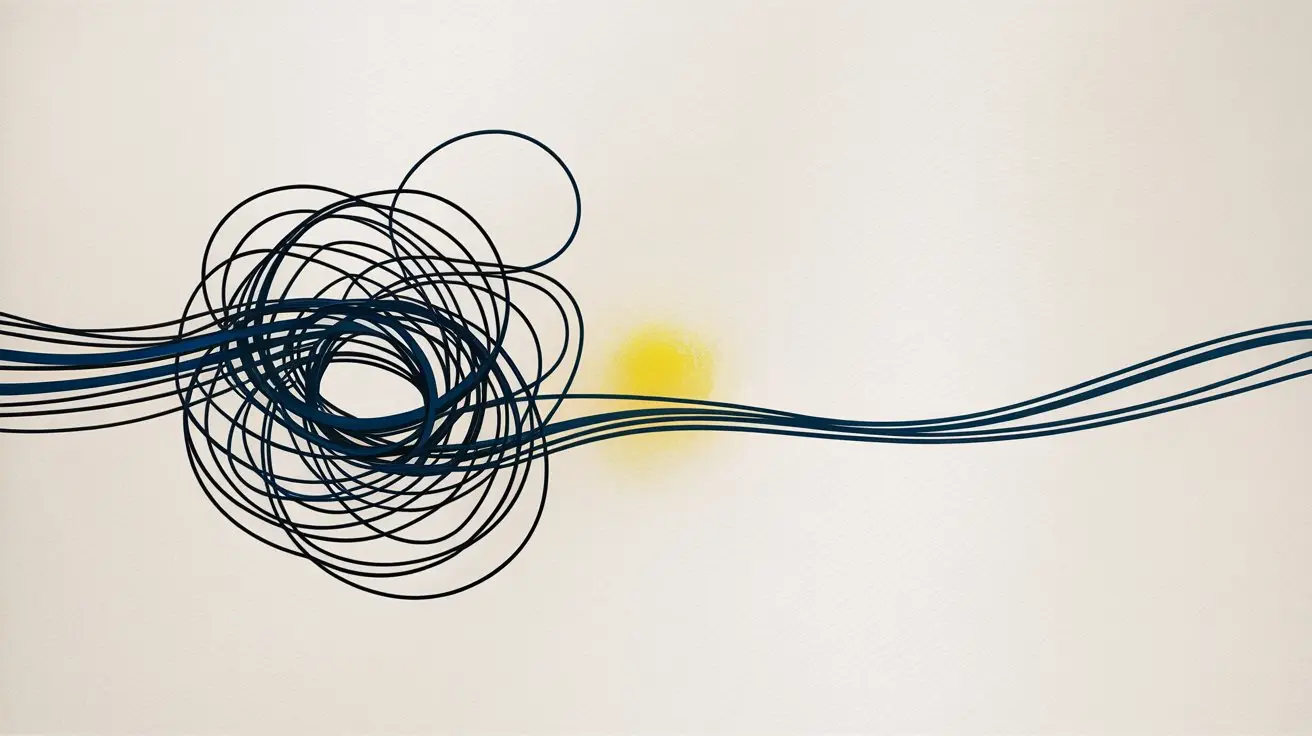
If you’ve ever thought, “I can’t stop thinking about this,” you’re not alone.
But there’s an important distinction most people never learn: some thinking helps you heal and grow, and some thinking keeps you trapped. When the thinking becomes repetitive, urgent, and certainty-seeking—especially around intrusive thoughts—it can become a mental compulsion.
That pattern is common in Pure-O OCD (often called “Pure Obsessional” OCD). The name is misleading. It’s not “pure obsessions.” It’s often obsessions + compulsions that happen internally—rumination, mental checking, mental reassurance, and mental review.
This article will help you tell the difference between reflection and rumination, why Pure-O rumination feels so convincing, and what you can do instead—without needing to “solve” the thought first.
First, what is Pure-O?
Pure-O is a label many people use when their OCD looks mostly internal.
Instead of obvious compulsions like washing, checking locks, or repeating actions, the compulsions happen inside the mind. They can include:
- Replaying the past to make sure you didn’t do something wrong.
- Analyzing what a thought “means” about you.
- Checking your feelings to see if you’re safe, certain, or “really okay.”
- Trying to mentally prove you’re a good person.
- Mentally neutralizing a thought with a phrase, prayer, or “correct” counter-thought.
- Researching endlessly for certainty (which often becomes a form of reassurance).
From the outside, it can look like you’re simply anxious or “in your head.” On the inside, it can feel like you’re fighting for your integrity, safety, relationships, or identity.
Reflection vs. Rumination: the difference that changes everything
Reflection is purposeful, time-limited, and moves you forward
Reflection is the kind of thinking that helps you learn, grieve, problem-solve, or make meaning. It has a beginning, middle, and end.
Reflection tends to sound like:
“What happened, and what can I learn?”
“What matters to me here?”
“What action would help?”
“What’s the next right step?”
Reflection usually leads to an outcome: a decision, a plan, self-compassion, a repaired conversation, a boundary, or acceptance.
Rumination is repetitive, urgency-driven, and keeps you stuck
Rumination is a loop. It feels like thinking, but it functions like a ritual. Its purpose is often not learning—it’s relief and certainty.
Rumination tends to sound like:
“But what if…?”
“Did I really…?”
“What does it mean that I thought this?”
“I need to be 100% sure.”
“I can’t move on until I understand this perfectly.”
Rumination can last minutes, hours, or days. It rarely produces an answer that lasts. Even when it temporarily calms you, the doubt tends to come back stronger.
Why rumination feels so convincing (and so necessary)
Pure-O rumination usually starts with an obsession—an intrusive thought, image, urge, or doubt that feels distressing or “not you.”
Then your mind offers a very persuasive idea:
“If I just think hard enough, I’ll get certainty. Then I’ll feel okay.”
The nervous system loves that promise. Relief feels like safety. But the relief is short-lived, because the brain learns a dangerous lesson:
“When you ruminate, you feel better. That means rumination must be important. Do it again next time.”
Over time, rumination becomes the brain’s go-to response to distress. It becomes automatic. And because it happens internally, it often goes unnoticed in treatment—especially if therapy focuses only on the content of your thoughts.
The Pure-O trap: the loop that keeps repeating
Most Pure-O cycles look something like this:
- A trigger happens (a situation, a sensation, a memory, a headline, a responsibility).
- An intrusive thought or doubt appears.
- Anxiety, shame, disgust, or fear spikes.
- Rumination begins to “fix” the feeling.
- You get temporary relief or partial certainty.
- The brain tags the thought as important and dangerous.
- The thought returns, stronger or more frequent.
- The loop repeats.
This is why Pure-O can feel like a full-time job. You aren’t just managing anxiety—you’re trying to achieve a standard the OCD mind demands: total certainty, total moral clarity, total safety, total control.
Rumination disguises (how it hides in plain sight)
One of the hardest parts about Pure-O is that rumination often sounds reasonable. It wears the costume of maturity and responsibility.
Here are common rumination disguises:
“I’m just processing.”
“I’m trying to be a good person.”
“I need to make sure I didn’t harm anyone.”
“I need to understand why I thought that.”
“I’m preventing future mistakes.”
“I’m taking responsibility.”
“I’m just being careful.”
“I’m trying to get closure.”
If the thinking is repetitive, urgent, and aimed at certainty or relief, it’s likely rumination—regardless of how noble it sounds.
A simple test: Does it lead to action, or does it lead to more thinking?
Try this question:
After I’ve been thinking about this for 10 minutes, am I closer to a concrete action—or am I deeper in the loop?
Reflection tends to produce an action.
Rumination tends to produce more rumination.
If you keep returning to the same questions, the same “what ifs,” and the same mental review, you are probably in a compulsion—not a meaningful reflection.
“But what if the thought is true?” (the question that traps you)
This is a core Pure-O experience.
OCD doesn’t usually show up as “I know I’m a bad person.” It shows up as:
“But what if I am?”
“But what if I missed something?”
“But what if this means something?”
The trap is that you can’t resolve OCD by answering “what if” questions to 100% certainty. The mind will always find another angle, another loophole, another doubt.
The goal is not to prove the intrusive thought false.
The goal is to stop treating it like a problem that must be solved right now.
What to do instead (the replacement response)
This is where change happens: you learn to respond to the urge to ruminate the same way you’d respond to the urge to check a lock repeatedly.
You don’t argue with the urge.
You don’t prove it wrong.
You don’t reassure it.
You practice a different response.
Here’s a practical three-step framework you can start using immediately.
Step 1: Name the process, not the content
Instead of “This thought is terrible,” shift to:
“My brain is offering an OCD doubt.”
“This is a rumination pull.”
“This is mental checking.”
Naming the process reduces the sense of emergency. You’re no longer inside the story—you’re noticing the pattern.
Step 2: Drop the ritual (even if you don’t feel ready)
This is the hard part. Rumination usually says, “Not yet. Just a little more thinking first.”
Treatment says, “This is the ritual. This is where we stop.”
Dropping the ritual might mean:
- Choosing not to replay the memory again.
- Choosing not to mentally reassure yourself.
- Choosing not to analyze what it means.
- Choosing not to search for the “perfect answer.”
This is not suppression. It’s response prevention.
Step 3: Return to the next right action
Your brain needs a “track” to return to—something concrete.
Return to what you were doing.
Return to your task.
Return to a values-based action.
If you don’t know what to return to, choose something small and physical: drink water, stand up, send the email, fold the laundry, take the next step in your routine.
The goal is not to feel certain. The goal is to live while uncertainty exists.
A compassionate reality: you may feel worse before you feel better
When you stop ruminating, anxiety often spikes. That’s normal.
Rumination is your brain’s current safety strategy. When you remove it, the nervous system protests. That protest is not danger. It’s withdrawal from a ritual.
Over time, with repetition, the brain learns something new:
“I can have this thought and not do the ritual.”
“I can feel uncertainty and still function.”
“I can tolerate discomfort and it passes.”
That’s freedom.
Five quick questions to identify rumination (self-check)
Ask yourself:
- Am I trying to get certainty or relief right now?
- Am I looping on the same question without resolution?
- Am I mentally reviewing, checking, or reassuring?
- Do I feel urgent pressure to “figure it out” before moving on?
- If I stop thinking, do I fear I’ll be irresponsible or unsafe?
If you answered “yes” to most of these, there’s a strong chance you’re dealing with rumination as a compulsion.
When you should get support (and why you’re not failing)
If rumination is taking hours, disrupting sleep, interfering with work, harming relationships, or creating intense distress, it’s worth getting help. Pure-O is highly treatable, but it often requires the right targets.
Many people try traditional counselling and leave feeling understood—but still stuck—because the mental compulsions were never clearly identified and treated.
- A focused approach typically includes:
- learning to spot mental rituals precisely
- building response prevention for rumination
- practicing “disengage and return” repeatedly
- using ACT-informed skills to handle discomfort without struggle
- connecting the work to your values so it’s sustainable
Ready for the next step?
If this article felt uncomfortably accurate, that’s not a diagnosis—but it is a sign that you may be stuck in a Pure-O loop.
You don’t need to be 100% sure before you get help. That’s the OCD rule. You can start with clarity instead.
We’re not telling you it’s going to be easy. We’re telling you it’s going to be worth it.