
If you’re considering an ADHD assessment, you’re probably looking for more than a label. You want an explanation that makes your life make sense—and a next step that’s realistic.
At STG Health, assessment is designed to do two things:
You don’t need to be certain it’s ADHD to begin. The process is built to create understanding step by step.
Already diagnosed? Start with Treatment & Therapy
Quick Read (60 seconds)
If you’re wondering whether it’s ADHD, this assessment gives clarity and direction—not just a label.
We combine intake + validated tools + clinical integration, so results make sense in real-life context.
Best for adults stuck with focus, organization, overwhelm, and emotional regulation.
You’ll leave with clear feedback + a written summary + a practical intervention plan (NP coordination when indicated).
Your plan points you to the right next step: Individual Therapy, Focused Mind/Balanced Heart, Skills Management, or Fully Tailored.
“Prefer to skim? Jump to: Assessment • Process • Intervention Plan • Resources”
Many adults come to assessment after years of pushing harder, masking, and privately wondering what’s wrong with them. When the pattern becomes clear—how your brain, emotions, nervous system, and environment interact—the next steps stop being guesswork.
Your intervention plan is built around direction, not perfection—so change can hold under real life.
Many adults arrive saying some version of:
“I can do things in short bursts… until I crash.”
“I’m either all-in or completely stuck.”
“I’m exhausted from trying to be consistent.”
The “wall” is usually the moment it becomes undeniable that effort isn’t the issue—capacity and overload are.
Assessment helps us name the pattern clearly, reduce self-blame, and build a plan that fits your nervous system and your life.
This is a structured, evidence-based clinical process designed to clarify whether ADHD is present and how it affects your functioning.
Your intervention plan is built around direction, not perfection—so change can hold under real life.
The goal is understanding and direction—not just a label.
No. Tools support clinical judgment—they don’t replace it. We focus on how challenges show up in real life and how the pattern holds together.
If you’ve lived with years of inconsistency, missed potential, or emotional whiplash, self-blame makes sense—but it’s rarely accurate. Assessment is designed to reduce shame by increasing clarity: what’s ADHD, what’s stress/burnout, what’s anxiety, what’s overload—and what helps.
Yes. The process is paced and collaborative. Some people need fewer steps; others benefit from a more comprehensive approach. We progress only as clinically appropriate and discuss decisions with you.
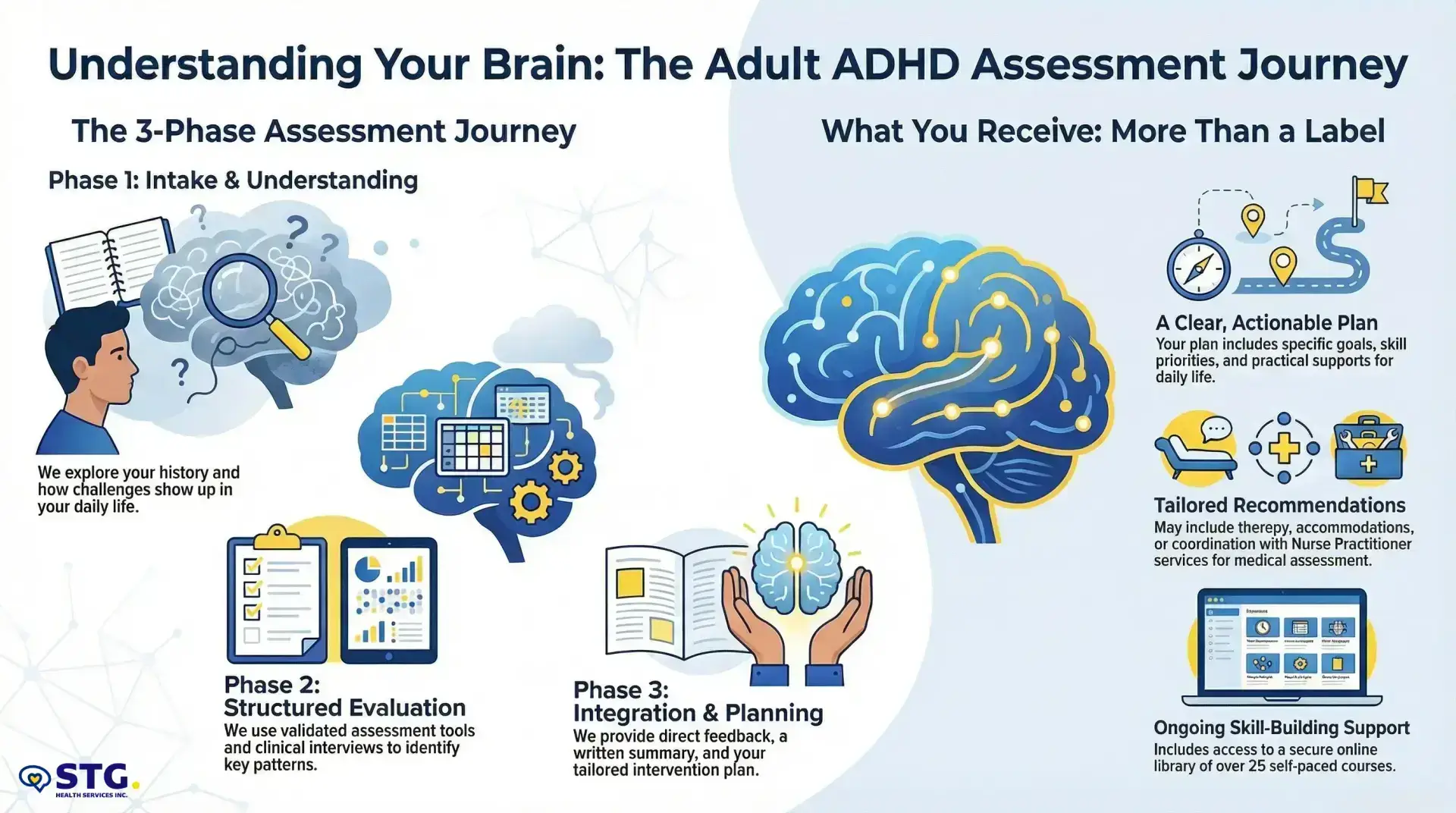
The assessment is structured, paced, and clinically grounded. It unfolds in three phases, each contributing to a clear understanding and coordinated next steps.
Progression through the assessment phases occurs only as clinically appropriate. Some individuals may require fewer steps, while others benefit from a more comprehensive process. Decisions are guided by clinical judgment and discussed collaboratively.
We begin with a comprehensive intake focused on understanding your concerns, history, and current functioning. Rather than working through symptom checklists alone, we focus on how challenges show up in daily life — including patterns related to attention, task management, emotional regulation, energy, and stress across work, relationships, and home.
This phase emphasizes context and meaning, helping us understand what you’re experiencing, what you’ve already tried, and what you’re hoping to gain from assessment.
In this phase, we use validated assessment tools and clinical interviews designed for adults. These tools support the identification of patterns related to attention, executive functioning, emotional regulation, and related areas.
Assessment tools are used to inform clinical judgment, not replace it. Findings are interpreted within the context of your history and lived experience, with an emphasis on integration rather than isolated scores.
Information from the intake and assessment is integrated using clinical judgment to form a clear and coherent understanding of your presentation. Medical and therapeutic recommendations are coordinated when helpful, and always guided by your needs and preferences.
You receive:
Direct verbal feedback
A written summary explaining findings in clear, practical language
A tailored intervention plan outlining recommended next steps
Intervention planning may include:
Therapeutic recommendations and skill-building support
Environmental, academic, or workplace accommodations
Referrals or coordination with other providers, when appropriate
Nurse Practitioner services, including medical assessment, medication consultation, or ongoing medical management, if indicated
Whether or not ADHD is confirmed, you’ll leave with an intervention plan that is specific and usable.
Your intervention plan may include:
Option A: Individual ADHD & Mental Health Therapy (ADHD + anxiety/burnout/relationship strain)
Option B: Focused Mind, Balanced Heart (emotional intensity, rejection sensitivity, reactivity/shutdown)
Option C: ADHD Skills Management Program (planning, routines, follow-through that fits your capacity)
Option D: Fully Tailored (a blended plan, for when you need both regulation + skills)
Following assessment, support may include therapy, skill-building, medical care, or a combination of approaches. Planning is collaborative and flexible, adapting as your needs change.
The goal is to support sustainable progress — not short-term fixes.
As part of your care, you may also receive access to the STG Online Clinic — a secure library of over 25 self-paced courses designed to support ongoing learning and skill development.
The Online Clinic is not a replacement for therapy or medical care. It is intended to complement your assessment and treatment plan, giving you practical tools you can return to between sessions and over time.
Courses focus on areas such as:
Executive function skills, including task initiation, follow-through, and planning
Emotional regulation tools to support focus, stress tolerance, and recovery after overwhelm
Building daily structure with ADHD, including routines that adapt to fluctuating energy and attention
Content is designed to be practical, accessible, and flexible, allowing you to engage at your own pace and revisit material as your needs change.