

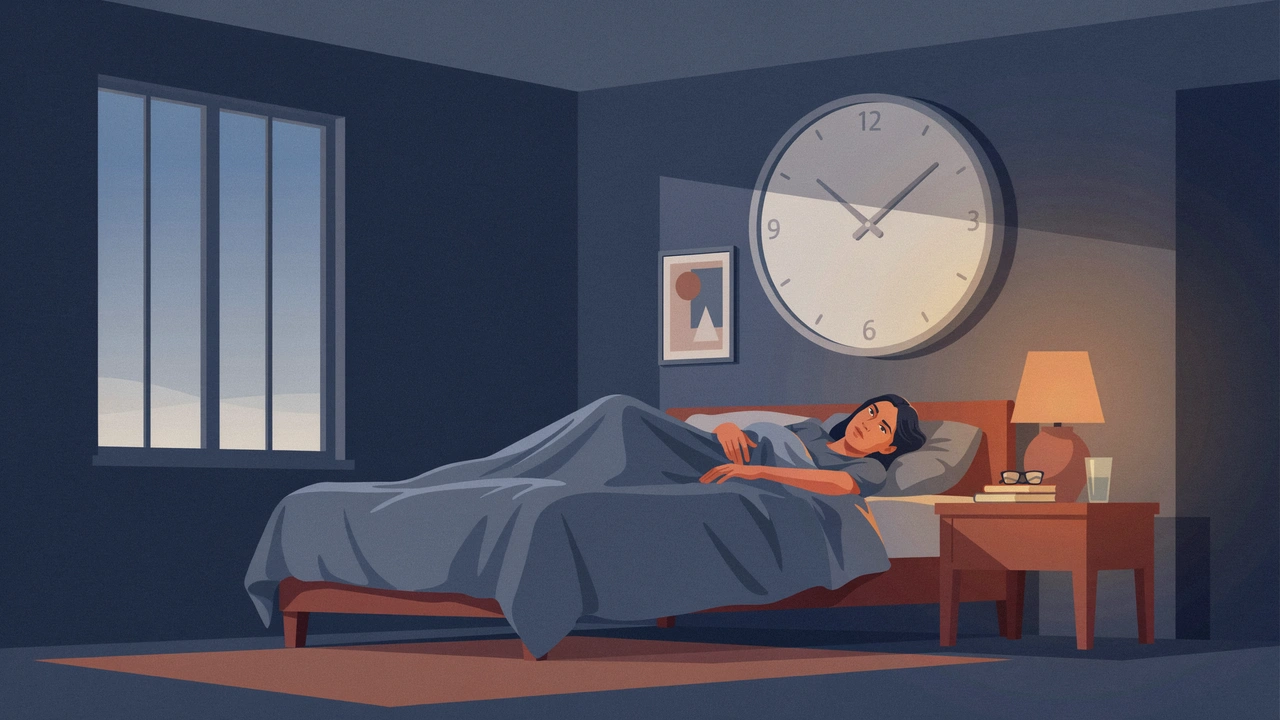
Most of the sleep advice you’ve been handed assumes your body clock works like everyone else’s and you’re just not trying hard enough. That’s the wrong starting point. For a large share of adults with ADHD, the problem isn’t willpower at 11 p.m. — it’s that your biological “go to sleep” signal fires an hour or more later than the schedule your job, your kids, and the rest of Saskatchewan expect you to keep.
That single reframe changes everything about what you should do next.
TL;DR: ADHD sleep trouble is often a circadian timing problem — a delayed body clock — layered with conditioned insomnia and a brain that treats “quiet” as a cue to wake up. The fix isn’t a stricter bedtime. It’s anchoring a steady wake time, getting light in the morning, dimming light at night, and using ADHD-adapted CBT-I to stop the bed from becoming a place you go to feel frustrated.
But here’s what most people miss:
- Forcing an early bedtime first usually backfires. You lie there wired, the bed starts to mean “failure,” and you’ve made the insomnia worse. Wake time and morning light are the levers that actually move the clock — bedtime follows.
- “Sleep hygiene” as a checklist is where ADHD brains go to fail. Ten-step wind-down routines are almost designed to collapse under time blindness and hyperfocus. Fewer steps, done consistently, beat an elegant routine you abandon by Wednesday.
- Your sleep tracker is probably lying to you about sleep stages — and the anxiety it creates can itself keep you awake. It’s useful for spotting broad patterns like your timing and regularity. It is not a diagnosis.
Scope and honesty note: This is a psychoeducational piece for adults with ADHD in Saskatchewan, including the shift workers, rotational crews, and remote-community folks we work with a lot. It’s not individualized sleep or medication advice. Behavioural sleep treatment works best after you’ve clarified what’s actually going on — and some sleep problems (apnea, restless legs, medication timing) need a physician, not a worksheet. More on that below.
Why your body clock runs late — and why that’s not a character flaw
Start with the mechanism, because it’s the thing nobody explained to you. A delayed circadian rhythm means your internal timing system — the one that releases melatonin in the evening and cortisol in the morning — is shifted later than the clock on the wall. In adults with ADHD, the release of melatonin (the “it’s getting dark, wind down” signal) tends to happen roughly an hour and a half later than in people without ADHD. Delayed sleep-wake timing shows up in something like three-quarters of adults with ADHD in the research, and sleep problems overall in the ballpark of eight in ten [PMC12728042; Van Veen et al., 2010].
Read those numbers carefully, though. They’re “up to” figures, and they vary a lot by age, medication, other diagnoses, and how you define a “sleep problem” in the first place. What’s solid is the direction: ADHD and a late-running clock travel together far more often than chance. What’s softer is any specific percentage. If a resource tells you “80% of people with ADHD have X” as though it’s a law of nature, be a little skeptical — good clinicians hold these as strong associations, not certainties.
Here’s the part that reframes the shame. If your natural sleep window is 1 a.m. to 9 a.m. and your life demands 10:30 p.m. to 6:30 a.m., you are not failing at sleep. You’re fighting a mismatch between your biology and your schedule. That’s a solvable engineering problem, not a moral one. And it’s a distinction that matters enormously for shift workers on the potash and uranium sites, in oilfield rotations, in health care, and behind the wheel on long northern hauls — because your schedule is often the one thing you can’t simply move.
Where this gets complicated: a delayed clock is the most common pattern, not the only one. Sleep-onset insomnia (can’t fall asleep), middle insomnia (wake at 3 a.m. and can’t get back), simple insufficient opportunity (you only gave yourself five hours), stimulant timing, anxious rumination, apnea, restless legs — these can each look like “ADHD sleep trouble” and each points to a different fix. Treating a 3 a.m. waking with a circadian intervention meant for a delayed clock is like fixing a flat tire by changing the oil. The step everyone skips is figuring out which problem they actually have.
The loop that keeps the problem alive
The direct answer to “why does this keep happening” is that ADHD sleep trouble is self-renewing. It’s not one bad night — it’s a loop, and each turn of it makes the next turn more likely.
It runs roughly like this. Sleep starts late, because the evening is finally quiet and self-directed and your clock is running behind anyway — so hyperfocus, avoidance, or plain revenge bedtime procrastination pushes the window later. Then morning becomes an emergency: you snooze, you rush, you miss the morning light that would have nudged your clock earlier and built pressure for tonight. So you patch the day — caffeine, a nap, more caffeine, low movement — which gets you through but quietly drains the sleep pressure you’d need to fall asleep at a reasonable hour. And so the evening becomes, again, the only calm and rewarding part of your whole day. Of course you don’t want to end it.
That last link is the one people underestimate. For a lot of adults with ADHD, staying up isn’t defiance — it’s the first moment all day that belongs to you. You have to respect that need and redirect it, not just white-knuckle against it. A wind-down plan that ignores why you’re staying up will lose every time.
The real-world reality: you don’t break this loop by fixing all four links at once with a heroic new routine. You break one link — usually the wake time and the morning light — and let the pressure it builds do some of the work on the others. Trying to overhaul everything on night one is the single most common way people set themselves up to quit by day four.
What actually works, roughly in order
If you do nothing else, do these — and do them in this sequence, because the sequence is doing real work.
Anchor a steady wake time. Every day, within about an hour, weekends included. This is the keystone. A stable wake time is the strongest signal you can send a drifting clock, and it’s the one most people sacrifice first because a rough night makes sleeping in feel deserved. Resist that. Sleeping in to “catch up” pushes tonight later and feeds the loop. If you’re on rotation and your schedule flips, you can’t hold one wake time — so instead you protect a consistent anchor within each block of shifts and manage the transitions deliberately. That’s genuinely harder, and it’s exactly the kind of thing individual sessions exist to problem-solve.
Get bright light into your eyes early. Morning light is the accelerator pedal for advancing a delayed clock — arguably more powerful than anything you do at night. In a Saskatchewan winter, when the sun comes up late and weak, that often means a proper light therapy lamp used shortly after waking, not just “opening the blinds.” The northern photoperiod is not a minor detail here; it’s a big part of why so many people up here feel their sleep fall apart from November through February.
Dim the light at night — but only as much as you’ll actually sustain. Warmer, lower light in the evening, screens turned down, and amber lenses if you’ll wear them. The clinical goal is less evening light hitting your eyes so your melatonin isn’t held back. The practical goal is a version of this you’ll still be doing in three weeks. A perfect protocol you abandon beats nothing by exactly nothing.
Use stimulus control to un-teach the bed. This is the CBT-I core, and it’s blunt: if you’ve been lying awake long enough that it feels prolonged — don’t clock-watch, just go by feel — get up, go somewhere dim, and do something deliberately boring until you’re sleepy, then return. The point is to stop your brain from pairing “bed” with “frustration, rumination, wide awake.” The ADHD adaptation is critical, though: decide on your boring out-of-bed activity in advance, keep it low-stimulation, and keep the steps minimal — because at 2 a.m. an ADHD brain will happily turn “get up briefly” into a 90-minute project.
Handle the catastrophic thought. “If I sleep badly tonight, tomorrow is ruined” is a thought that generates the exact arousal that ruins the night. It’s a self-fulfilling prophecy with a feedback loop attached. The CBT-I move is to soften it toward something true and less alarming — “I’ve functioned on bad sleep before; I’ll manage” — which lowers the stakes enough to let sleep actually come.
A word on melatonin, carefully. Melatonin, used for a delayed clock, is a timing signal, not a sedative — low dose, taken earlier in the evening, to nudge the clock rather than knock you out. That’s a real and useful distinction. But dose, timing, formulation, and interactions matter a great deal, especially if you take stimulant medication, an antidepressant, or other psychotropics. This is a “talk to your prescriber” item, not a “grab a bottle at the pharmacy and guess” item. Same goes, more emphatically, for the diphenhydramine and doxylamine sleep aids: they sedate, but sedation isn’t restorative sleep, and leaning on them nightly is a pattern that warrants a clinician’s eyes.
Which problem do you actually have? A quick sort
Behavioural sleep work only lands if it’s aimed at the right target. Use this as a starting map, not a diagnosis.
| If your main pattern is… | It looks like… | First move | When to get medical input first |
|---|---|---|---|
| Delayed clock | You can sleep — just late. Fine on holidays when you set your own hours. | Steady wake time + morning bright light | If timing shift is extreme or lifelong and unbudging |
| Sleep-onset insomnia | You’re tired but can’t fall asleep; mind won’t quiet | Stimulus control + the catastrophic-thought reframe | If it’s paired with loud snoring or breathing pauses |
| Middle insomnia (3 a.m. wake) | You fall asleep fine, then wake and can’t return | Stimulus control on the wake-up; check alcohol, worry | If waking is with gasping, choking, or urgent — apnea screen |
| Insufficient opportunity | You simply don’t give sleep enough hours | Protect the window before adding techniques | Rarely medical — it’s a scheduling problem |
| Restless legs / limb movements | Crawling urge to move legs at rest; partner reports kicking | — | Physician assessment; behavioural tools won’t fix this |
When to skip straight to a physician or sleep specialist: loud snoring with breathing pauses or gasping, unrefreshing sleep no matter the hours, a strong urge to move your legs at night, acting out dreams, or sleep problems tangled up with severe depression, possible bipolar-spectrum activation, or a new medication. These aren’t things a sleep diary solves, and chasing them with behavioural strategies just delays the help you need.
On sleep trackers — an if-then: If you want to spot broad patterns — how regular your timing is, when you’re actually falling asleep, week-over-week trends — then a wearable is genuinely useful, read loosely. If you’re reading its “deep sleep: 43 minutes” as clinical fact and feeling anxious about the number, then it’s working against you. Consumer wearables aren’t equivalent to a sleep-lab study and can’t reliably stage your sleep. Some people develop real anxiety chasing their sleep scores — there’s even a name floating around for it, orthosomnia. If your tracker is making you a worse sleeper, the intervention is to take it off.
A starter checklist (with honest effort ratings)
- Set one wake time and hold it 7 days a week. Difficulty: high. Payoff: highest. This is the hard one and the one that matters most. Give it two to three weeks before you judge it.
- Get bright light within ~30 minutes of waking (lamp in winter). Difficulty: low–moderate. Payoff: high. The winter version takes equipment and a minute of setup.
- Pre-plan your boring 2 a.m. activity so it exists before you need it. Difficulty: low. Payoff: high. Ten minutes of planning now saves the whole strategy later.
- Pick one evening light change you’ll actually keep. Difficulty: low. Payoff: moderate. One sustained change beats five you drop.
- Write down the catastrophic sleep thought and its calmer replacement. Difficulty: low. Payoff: moderate–high. Cheap to do, quietly powerful.
- Screen yourself for the red-flag medical signs above. Difficulty: low. Payoff: potentially critical. Two minutes that might redirect the whole plan.
Realistic timeline: most people don’t feel a delayed clock genuinely shift in a few days. Circadian change is measured in weeks, and the first week of holding a wake time often feels worse before it feels better. That dip is normal and expected — knowing it’s coming is half of not quitting.
Where this evidence is solid, and where it isn’t
The strongest ground here: CBT-I is the first-line, well-evidenced treatment for insomnia across many populations, and its core mechanisms — stimulus control, sleep scheduling, cognitive work on sleep beliefs — are well established [PMC10624170]. The link between ADHD and a delayed circadian phase is robust and replicated, including objective markers like delayed melatonin onset [PMC12728042].
Where it’s genuinely softer: exact prevalence numbers bounce around by study, population, and definition — treat any single percentage as illustrative. The ADHD-specific adaptation of CBT-I is clinically sensible and grounded in solid principles, but the dedicated trial base for “CBT-I modified for ADHD” is thinner than the base for CBT-I generally; a lot of good practice here is extrapolation done carefully, and it’s honest to say so. Melatonin and light-timing protocols work best individualized, and their effects are real but modest — nudges, not switches.
The practical foundation for how this is framed comes from clinical work with ADHD adults across northern and central Saskatchewan — shift workers, rotational crews, parents, and remote-community clients — where the recurring lesson is the same: the intervention that fits the actual schedule and the actual brain beats the theoretically optimal one every time.
Where this is heading: the more interesting frontier is treating ADHD-related circadian delay as a lever on ADHD symptoms themselves — early trials suggest that advancing the clock can improve daytime attention and regulation, not just sleep. That’s promising and still developing; watch it, don’t bank on it yet.
If any of this sounds like your nights, the honest next step is to figure out which pattern you’re running — because the right first move is different for each one. That’s the whole design of our ADHD Sleep Reset: eight weeks of ADHD-adapted CBT-I that starts by clarifying your pattern, then changes one link at a time instead of handing you another impossible checklist. If your schedule is genuinely irregular — rotation, nights, a young kid — the one-to-one sleep option exists precisely for the cases a group can’t personalize enough.